
Iragbiji, the town of Chief Muraina Oyelami

running up the hill
running up the hill
Iragbiji is a small but lively town, in Osun state, surrounded by hills made of curvy rocks emerging from the plain and partly patched with green. It is part of Yorubaland, about sixty kilometres East of Osogbo. The heart of the town is the palace of the Oba (King of the area) next to a yellow multi-storeyed central mosque. The Oba is a muslim.
the Oba of Iragbiji
the Oba of Iragbiji
Chief Muraina Oyelami, a versatile artist born in 1940, is residing in Iragbiji. He is both a talented talking-drum player and a painter. He welcomed us in his house for a talk on Yoruba culture especially about the talking drums which evolved in shape overtime to the modern form of goat skin cylinder whose sound can be altered by squeezing the ropes that are tied along the circumference of the drum to produce tons and therefore allows to emulate the Yoruba language through rhythm and tonality.
three sets of Yoruba drums
There are actually three types of drums each playing a specific role in the intricate design of percussions which constitute the backbone of Yoruba music. Other instruments are a modern addition and may somehow be perceived as superfluous. Percussion and voice are the essence of Yoruba music. Dance complements it to embody the expression of a particular message or theme.
Tradition is therefore expressed and remembered as a combination of those three elements.
The masquerade, where a Egungun (ancestor spirit) is dancing to the tune of the drums or rather conversing with the drums is one example of it.
the Egungun interacting with the talking-drum player
The Oba gave us an audience the next day. He was wearing a beaded crown. Probably in his fifties, he welcomed us and talked about the ambiguous relationship with Westerners and acknowledged that it was important for Westerners to understand what life was like in Iragbiji, among other places in Yorubaland, and not fall into the trap of the usual cliches that Westerners, who never travelled, would normally have about Nigeria.
His twenty four wives (if I recall well) danced and sung for us to the sound of the drums. A lady was in charge of singing the praise of the Oba.
Chief Muraina Oyelami
We explored the hill overlooking the city which hosts a shrine at its top (a rather small and rusted enclosure encompassing a bush). A lovely walk with 360 degree perspective.
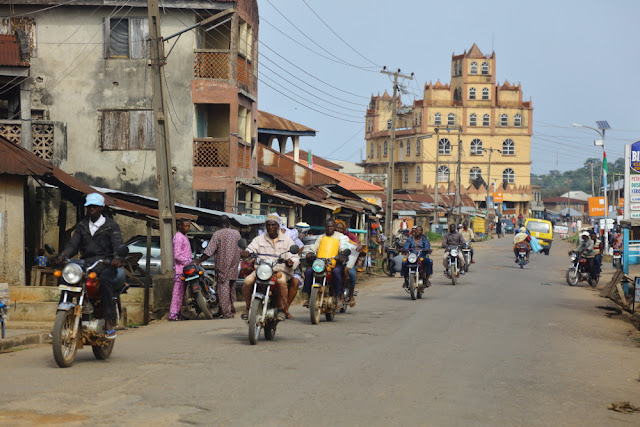
Iragbiji's main street

Comments

Popular posts from this blog

Egbe festival in Oyo: celebrating the duality of the living and the spirits

Ladies in pink from the northern procession The Yoruba traditional festival of Egbe Alaso Osun celebrates the celestial community of humanity a nd marks the communion of the world of the living and the “spiritual realm” (the world of the Spirits). During the day, celebrations consists in processions coming from two compounds and going to the palace of Alaafin before returning where they originated. The night before until early morning hours, sacrifices and offerings of food, among other things, are made throughout the town to feed the Spirits. We participated to a procession from the compound o f Ile Adedeji. The procession came from the North towards the palace of the Alaafin to pay him homage and it was joined by another one coming from the South. Both converged at the roundabout in front of the palace walls. The processions where essentially composed of women. The colour code of the southern one was pink while the northern one was blue and brown. ladies in blue from ...

The Ogiamien family in Benin City: about wood and history

Roland Ogiamien in his wood-carving workshop Wood Roland Ogiamien is a renown wood carver. He is now retired in his home town of Benin City and is now in his 80s. We met him in his simple workshop, a barn opened on the surrounding greenery. A part of the studio is used to store wood pieces and make sure they are well dried. He is using a collection of german ustensils to carve and polish the wood. He spent most of his career working out of Lagos before relocating to Benin. Roland was explaining that the wood he uses today is different that the one he worked on in his early days. Ebony has become rare and wood carvers have had to switch to other types of wood. Traditional heritage is a large part of his inspiration which he translates on wood with his own particular style, exploring various techniques for the finish of his pieces. Roland Ogiamien and two of his favourite masks History Ogiamien is the name of an important royal family in Benin Kingdom. Towards the end of the ...

the Alaafin of Oyo: the traditional ruler of the Yoruba

the Alaafin of Oyo and a few wives From the origin of the Yorubas to the Alaafin Olodumare is the name of the Supreme being in Yoruba language. He created  the Universe and all divinities (Irunmole), to whom he had delegated His powers on the creation of the earth and the humanity. Obatala was the first divinity to be created and had the responsibility to complete the creation of the earth and to mold the humans. Obatala in turn created Oduduwa, who the first human being living on the earth and the progenitor of all Yorubas. Oduduwa had one son called Akanbi, who got several sons, the last of which, called Oranyan is the ancestor of the Alaafin of Oyo. The Alaafin of Oyo is the traditional ruler of all Yorubas as he is blood-related to Oduduwa. In contrast the Ooni of Ife is a priest in charge of serving Oduduwa by taking care of the left spiritual property.  He is therefore a spiritual ruler of the Yorubas and not blood-related to the Yoruba progenitor. the...