Afropolitan Vibes: monthly live music at Freedom Park

Afropolitan style
Afropolitan style
It rained gently the whole evening, not enough to discourage the crowd from gathering at Freedom Park to listen to an eclectic mix of nigerian singers and musicians. That was a blessing after seeing the sky tormented by distant lightnings, it was probably pouring a few kilometers away.
Afropolitan Vibes is a monthly live music concert gathering of nigerian musicians and singers from all musical styles: Afro-beat/ hip hop/ pop and highlife.
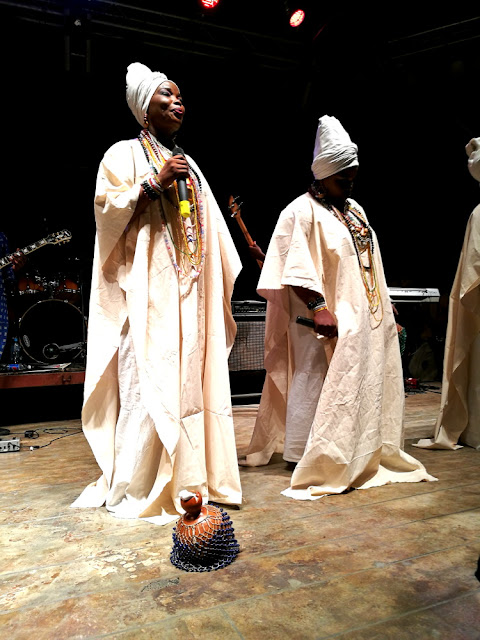
Adunni and Nefretiti
The party has become very popular over the years, people are still coming en-masse despite the recent steep price increase of the entry tickets. The increase has helped improve the quality of sound as a result of more money being spent on the sound system.
The show started with Bantu, 2 Nigerian - German brothers, who powered the evening. They invited Musiliu Haruna Ishola, famous for singing Apala music which originated in the 1930s as wake-up call during ramadan in yoruba land, a joyful call for breakfast, which evolved over time to become a full-blown music composition where drums and voice have been joined by keyboard, guitar, saxophones and trumpet. Musiliu is  the son of a very famous Apala eponymous singer.
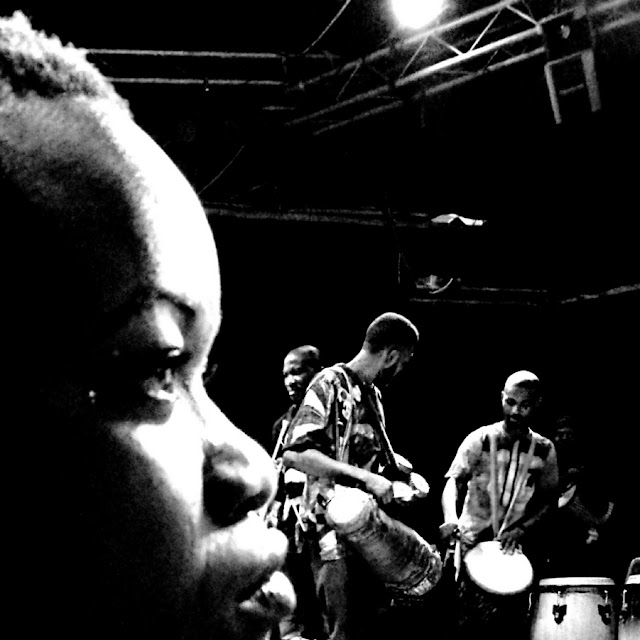
Musiliu  Haruna Ishola and his drummers
Musiliu  Haruna Ishola and his drummers
Then came Adunni and Nefertiti, two female singing yoruba folk music, dressed in large beige dresses assorted to their head gear.
Jazzman Olofin was the rapper of the evening. Finally, Bez, a short man from Jos wearing a panama-style hat, heavy black-framed glasses and an electric guitar played two songs. That was a bit short indeed!
Bez with assorted pants and guitar

Comments

Popular posts from this blog

The Ogiamien family in Benin City: about wood and history

Roland Ogiamien in his wood-carving workshop Wood Roland Ogiamien is a renown wood carver. He is now retired in his home town of Benin City and is now in his 80s. We met him in his simple workshop, a barn opened on the surrounding greenery. A part of the studio is used to store wood pieces and make sure they are well dried. He is using a collection of german ustensils to carve and polish the wood. He spent most of his career working out of Lagos before relocating to Benin. Roland was explaining that the wood he uses today is different that the one he worked on in his early days. Ebony has become rare and wood carvers have had to switch to other types of wood. Traditional heritage is a large part of his inspiration which he translates on wood with his own particular style, exploring various techniques for the finish of his pieces. Roland Ogiamien and two of his favourite masks History Ogiamien is the name of an important royal family in Benin Kingdom. Towards the end of the ...

Iragbiji, the town of Chief Muraina Oyelami

running up the hill Iragbiji is a small but lively town, in Osun state, surrounded by hills made of curvy rocks emerging from the plain and partly patched with green. It is part of Yorubaland, about sixty kilometres East of Osogbo . The heart of the town is the palace of the Oba (King of the area) next to a yellow multi-storeyed central mosque. The Oba is a muslim. the Oba of Iragbiji Chief Muraina Oyelami , a versatile artist born in 1940, is residing in Iragbiji. He is both a talented talking-drum player and a painter. He welcomed us in his house for a talk on Yoruba culture especially about the talking drums which evolved in shape overtime to the modern form of goat skin cylinder whose sound can be altered by squeezing the ropes that are tied along the circumference of the drum to produce tons and therefore allows to emulate the Yoruba language through rhythm and tonality. three sets of Yoruba drums There are actually three types of drums each playing a specific ro...

Lagos Island - Balogun market

hot sales Lagos urban area is said to count around 20 million inhabitants. 1 million additional everyday. People say Lagos is like a giant market and one of its epicenter is Lagos Island. Besides former colonial administrative buildings and the banks and insurance who built skyscrapers along the Marina, there is a large area devoted to trading and markets. The densest one is probably Balogun market which is located between the central mosque and Tinubu square. Three or four floors of shops, people, goods all so tightly packed that cars are not welcome and motorbikes have a hard time moving. pick what you need During the day 4 million people are coming to Lagos Island to do business. They will rent a space for an hour, half a day, a day or longer and trade. hen lost in the clothes section One can find pretty much everything, one needs only know where things are. But generally organised by specialized clusters. There is so much happening that one can only get a small glimps...