coming to Lagos Island

Lagos Island, the old business center

Back to the 70's

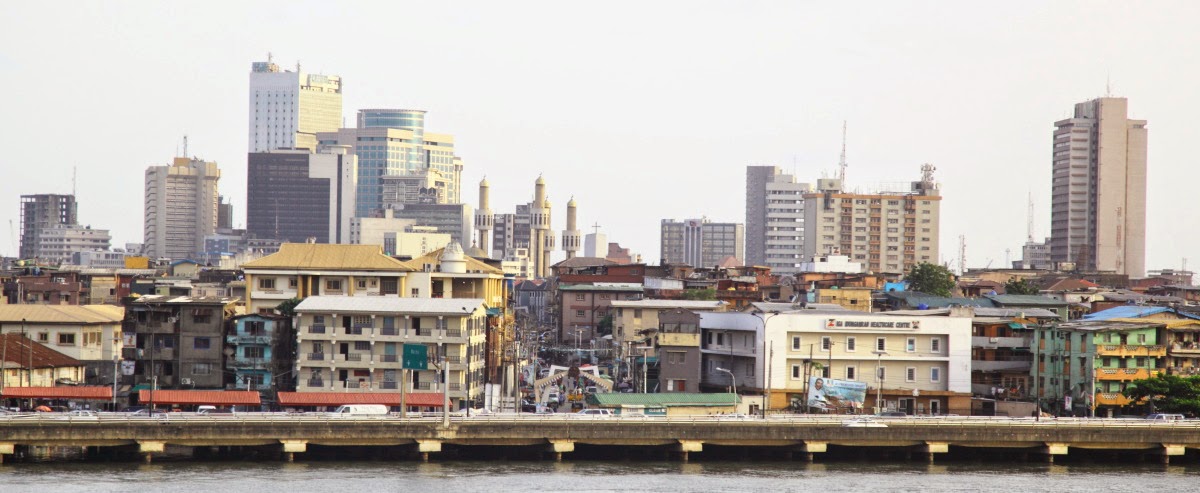
what is striking about Lagos Island is the amount of ageing concrete buildings worn out by the heat, the salt and the humidity. It was probably at its peak in the late 60s or 70s.
The streets are generally one-way and narrow, full of bustle and traffic during the day. Life is everywhere on the street, even late at night. Government offices are still partly there. The Central Bank building towers it.
Lagos Island is actually the link between Mainland, Ikoyi and Victoria Island.

Freedom park, the old prison

The old prison was turned into an event space called "freedom park" accessed from prison street. This is a popular hangout place for middle-class Nigerians and foreigners. It is hosting a monthly edition of Afropolitan Vibes, an evening when local bands come and play.
This year, it hosted the Lagos Jazz Festival, which is displaying local bands playing all sorts of music with a possible jazzy twist to it.

The heart of the city

wood and corrugated iron versus concrete
When driving from the mainland, the modest skyline appears magically about the water of the lagoon. It comes as a stark contrast to the wooden huts that have grown on the water edge and which host wood workshops. 
Timber is indeed carried over here by water way. Trunks are assembled in rafts which are filling up a large part of the lagoon and on which locals are walking. This is a convenient storage place.

floating timber

Comments

Popular posts from this blog

Egbe festival in Oyo: celebrating the duality of the living and the spirits

Ladies in pink from the northern procession The Yoruba traditional festival of Egbe Alaso Osun celebrates the celestial community of humanity a nd marks the communion of the world of the living and the “spiritual realm” (the world of the Spirits). During the day, celebrations consists in processions coming from two compounds and going to the palace of Alaafin before returning where they originated. The night before until early morning hours, sacrifices and offerings of food, among other things, are made throughout the town to feed the Spirits. We participated to a procession from the compound o f Ile Adedeji. The procession came from the North towards the palace of the Alaafin to pay him homage and it was joined by another one coming from the South. Both converged at the roundabout in front of the palace walls. The processions where essentially composed of women. The colour code of the southern one was pink while the northern one was blue and brown. ladies in blue from ...

The Ogiamien family in Benin City: about wood and history

Roland Ogiamien in his wood-carving workshop Wood Roland Ogiamien is a renown wood carver. He is now retired in his home town of Benin City and is now in his 80s. We met him in his simple workshop, a barn opened on the surrounding greenery. A part of the studio is used to store wood pieces and make sure they are well dried. He is using a collection of german ustensils to carve and polish the wood. He spent most of his career working out of Lagos before relocating to Benin. Roland was explaining that the wood he uses today is different that the one he worked on in his early days. Ebony has become rare and wood carvers have had to switch to other types of wood. Traditional heritage is a large part of his inspiration which he translates on wood with his own particular style, exploring various techniques for the finish of his pieces. Roland Ogiamien and two of his favourite masks History Ogiamien is the name of an important royal family in Benin Kingdom. Towards the end of the ...

the Alaafin of Oyo: the traditional ruler of the Yoruba

the Alaafin of Oyo and a few wives From the origin of the Yorubas to the Alaafin Olodumare is the name of the Supreme being in Yoruba language. He created  the Universe and all divinities (Irunmole), to whom he had delegated His powers on the creation of the earth and the humanity. Obatala was the first divinity to be created and had the responsibility to complete the creation of the earth and to mold the humans. Obatala in turn created Oduduwa, who the first human being living on the earth and the progenitor of all Yorubas. Oduduwa had one son called Akanbi, who got several sons, the last of which, called Oranyan is the ancestor of the Alaafin of Oyo. The Alaafin of Oyo is the traditional ruler of all Yorubas as he is blood-related to Oduduwa. In contrast the Ooni of Ife is a priest in charge of serving Oduduwa by taking care of the left spiritual property.  He is therefore a spiritual ruler of the Yorubas and not blood-related to the Yoruba progenitor. the...