
Badagry, the Point of no Return

the point of no return in Badagry
Badagry lies on the sea just a few kilometers east from the border between Nigeria and Benin. It is a peaceful town with a past. It was one of the place where slave traders met with buyers. The slaves were quartered in a compound by the lagoon side in small stuffy rooms. The guide was saying 40 people were locked in a cell of roughly 10 to 15 square meters. No bathroom, no place to ease yourself, just the ground. The low ceiling was preventing a good aeration and most definitely the rise of heat.
Slaves were usually captured by local tribes from warring neighbours: selling prisoners to Europeans was a good way to dispose of them for goods in exchange such as large umbrellas, guns, porcelain, etc... For those sold, they had to face the journey from their cell to the sea, at the Point of no Return, where they would board on ships to be ferried away into the unknown.
one last sip before...
First they had to cross the lagoon on a boat and then walk a kilometer and a half with their chains over the slave route. There was one mandatory stop at the drinking station (the slave spirit attenuation well) where they had to drink, whether they like it or not, before boarding on the ship. They would be severely beaten if they didn't. Most of them had never see the sea before. They were most probably terrified by the waves which made getting on the ship not that easy.
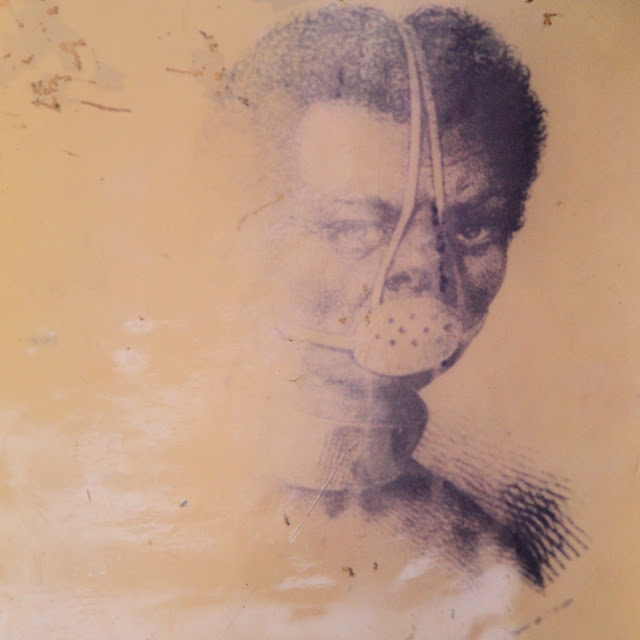
when the talking ain't easy
The museum was displaying all sorts of chains and taming tools, all more horrible than the others.

Comments

Popular posts from this blog

The Ogiamien family in Benin City: about wood and history

Roland Ogiamien in his wood-carving workshop Wood Roland Ogiamien is a renown wood carver. He is now retired in his home town of Benin City and is now in his 80s. We met him in his simple workshop, a barn opened on the surrounding greenery. A part of the studio is used to store wood pieces and make sure they are well dried. He is using a collection of german ustensils to carve and polish the wood. He spent most of his career working out of Lagos before relocating to Benin. Roland was explaining that the wood he uses today is different that the one he worked on in his early days. Ebony has become rare and wood carvers have had to switch to other types of wood. Traditional heritage is a large part of his inspiration which he translates on wood with his own particular style, exploring various techniques for the finish of his pieces. Roland Ogiamien and two of his favourite masks History Ogiamien is the name of an important royal family in Benin Kingdom. Towards the end of the ...

The mysterious stones images of Esie

turned into Stones Chief J. Agbo Ooye had been waiting in the shade of a large tree, in front of the National Museum of Esie, dressed in ceremonial costume with a velvet hat incrusted with crystal beads sown in the shape of his title and his name. He was sitting next to his wife on a bench, expecting our arrival. His wife, he would tell us later, was his best friend and she was actually demonstrating it by guiding his frail body from one place to another and guiding his hand when it came to sign autographs of his books. Chief Agbo Ooye is the author of two booklets on the Esie Stones. The first one, called A Personal Account of the Esie Stones is giving an overview of the differences between the scientific and the traditional interpretation of the Esie Stones. The second one is called the History of Esie and gives a brief account of Esie's history from the early settlement of Yorubas in various groups (Esie, Oro, Eku Apa, Igbonla, Edidi, Igbesi, etc...) to the present...

Iragbiji, the town of Chief Muraina Oyelami

running up the hill Iragbiji is a small but lively town, in Osun state, surrounded by hills made of curvy rocks emerging from the plain and partly patched with green. It is part of Yorubaland, about sixty kilometres East of Osogbo . The heart of the town is the palace of the Oba (King of the area) next to a yellow multi-storeyed central mosque. The Oba is a muslim. the Oba of Iragbiji Chief Muraina Oyelami , a versatile artist born in 1940, is residing in Iragbiji. He is both a talented talking-drum player and a painter. He welcomed us in his house for a talk on Yoruba culture especially about the talking drums which evolved in shape overtime to the modern form of goat skin cylinder whose sound can be altered by squeezing the ropes that are tied along the circumference of the drum to produce tons and therefore allows to emulate the Yoruba language through rhythm and tonality. three sets of Yoruba drums There are actually three types of drums each playing a specific ro...